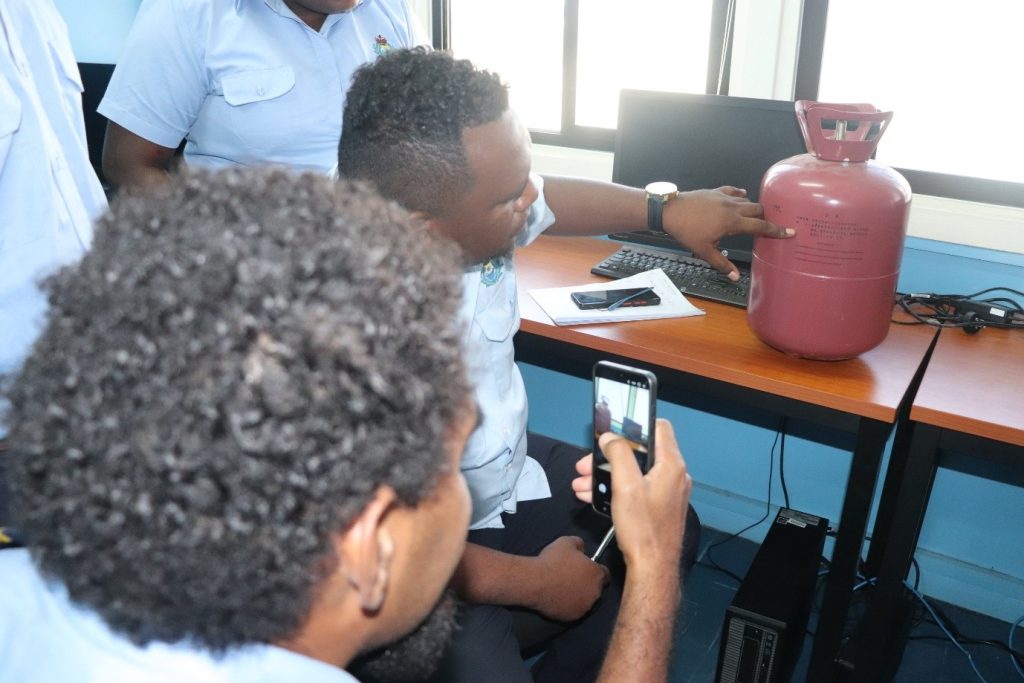
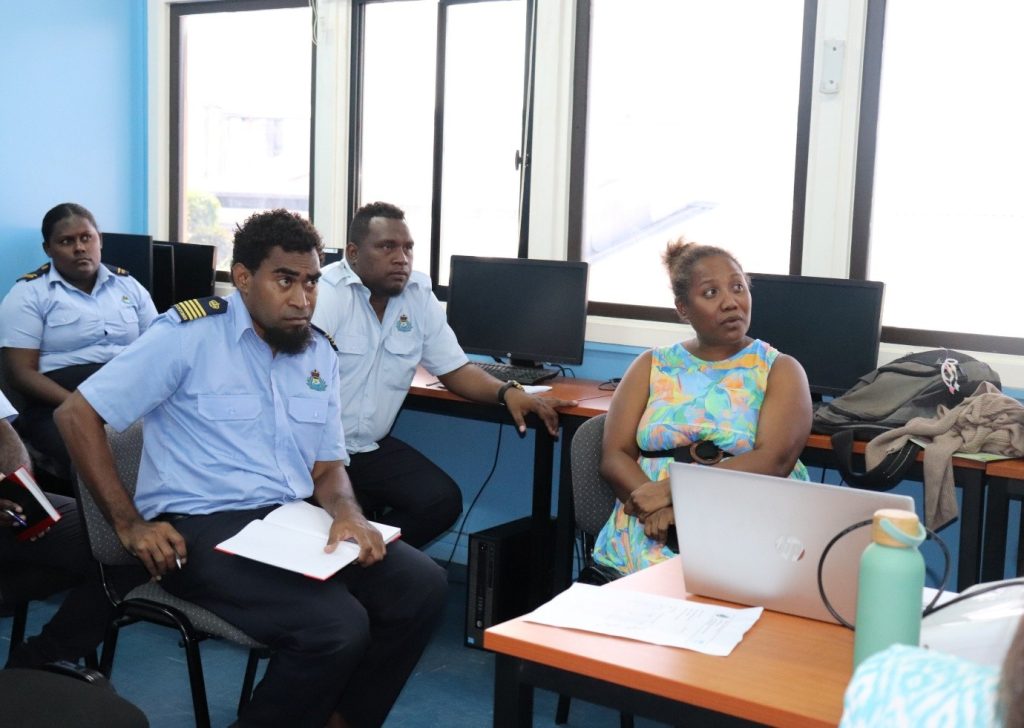
Honiara, Solomon Islands, Thursday 06th March 2026 – THE Solomon Islands Customs and Excise Division (SICED) Enforcement officers train on the Control and Monitoring of Ozone Depleting Substances (ODS) and Hydrofluorocarbons (HFCs) gases.
Customs officers working within the Key Customs Operational sector, which includes the Compliance and the long-Room Revenue Sections, undergo the training. The training was facilitated by Senior Technical Officers from the Ministry of Mines, Energy and Rural Electrification (MMERE), Energy National Ozone Unit, with the support of the United Nations Environment Programme (UNEP) officer Ms. Vika Rogers at the Customs Headquarters in Honiara.
The training aimed to strengthen the capacity of Customs and enforcement officers to effectively monitor and control the importation of ozone-depleting substances (ODS) and hydrofluorocarbons (HFCs) in line with the obligations of the Montreal Protocol. This will improve officers’ understanding of the licensing and quota system, enhance their ability to identify refrigerants and refrigeration equipment at the border, and support compliance with national regulations and international commitments.
Ministry of Mines, Energy and Rural Electrification Chief Energy Officer (National Ozone Officer) Ms. Mariana Nonga, who facilitated the training, stated that the Customs and Enforcement officers play a critical role as the first line of defence at our Country’s Borders and their work helps ensure that controlled substances are imported legally and within approved quotas.
“Strengthening their knowledge and skills allows them to better detect illegal shipments, verify documentation, and prevent the entry of banned or restricted refrigerants.
“By improving enforcement capacity, the training supports the country’s efforts to protect the ozone layer and manage climate-impacting gases responsibly,” said the Principal Energy Officer, Ms. Nonga.
Key topics covered during the training include the overview of the Montreal Protocol and national obligations, understanding ozone-depleting substances (ODS) and hydrofluorocarbons (HFCs), Import licensing and quota systems for controlled substances, and identification of refrigerants and refrigeration equipment.
The officers are trained to identify the Tariff Harmonized System (HS) codes related to various refrigerants and refrigeration equipment, Monitoring and Reporting procedures for imports, and Practical approaches to detecting illegal or mis-declared shipments, as well as the coordination mechanisms between Customs and the National Ozone Unit to ensure proper monitoring and reporting of refrigerant imports.
“Well-trained officers are better equipped to enforce regulations, prevent illegal trade, and support the country’s transition to environmentally friendly technologies.
“The training provided a valuable opportunity for Customs officers to strengthen their understanding of ozone protection policies and the regulation of refrigerants.
“The active participation and engagement of officers demonstrated their strong commitment to protecting the environment while ensuring compliant and efficient trade practices in Solomon Islands,” Nonga stressed.
SI Customs maintains a high level of Strong collaboration between agencies such as the national energy regulatory authorities and industry stakeholders, which is essential for the effective implementation of environmental regulations. By working closely together, agencies can share information, coordinate enforcement actions, and ensure that policies are implemented consistently. This cooperation helps strengthen border control, improve compliance with environmental regulations, and supports sustainable management of refrigerants throughout their lifecycle.
In the Solomon Islands, strengthening customs capacity helps ensure that trade in controlled substances is properly regulated while facilitating legitimate trade. The United Nations Environment Programme (UNEP) supports capacity building for customs officers as part of global efforts to assist countries in meeting their commitments under the Montreal Protocol.

The Government also acknowledges the continued technical and capacity-building support provided by UNEP in strengthening the capabilities of Customs and enforcement officers and supporting the country’s implementation of the Montreal Protocol.
The collaboration between national authorities and international partners remains essential in ensuring effective enforcement, improved compliance with environmental regulations, and the protection of the ozone layer for future generations.
The Ozone-depleting substances (ODS) and hydrofluorocarbons (HFCs) are human-made gases primarily used in refrigeration, air conditioning, and foam insulation. While they share similar industrial applications, their environmental impacts and regulatory histories differ significantly.
The Montreal Protocol is a globally ratified treaty (197 parties) that mandates the phase-out of nearly 100 ozone-depleting substances (ODS) and the phase-down of hydrofluorocarbons (HFCs) under the Kigali Amendment. National obligations include mandatory phase-out schedules, data reporting, import/export licensing systems, and bans on trading-controlled substances with non-parties
With Photos.
THE END///…
SICED PRESS